
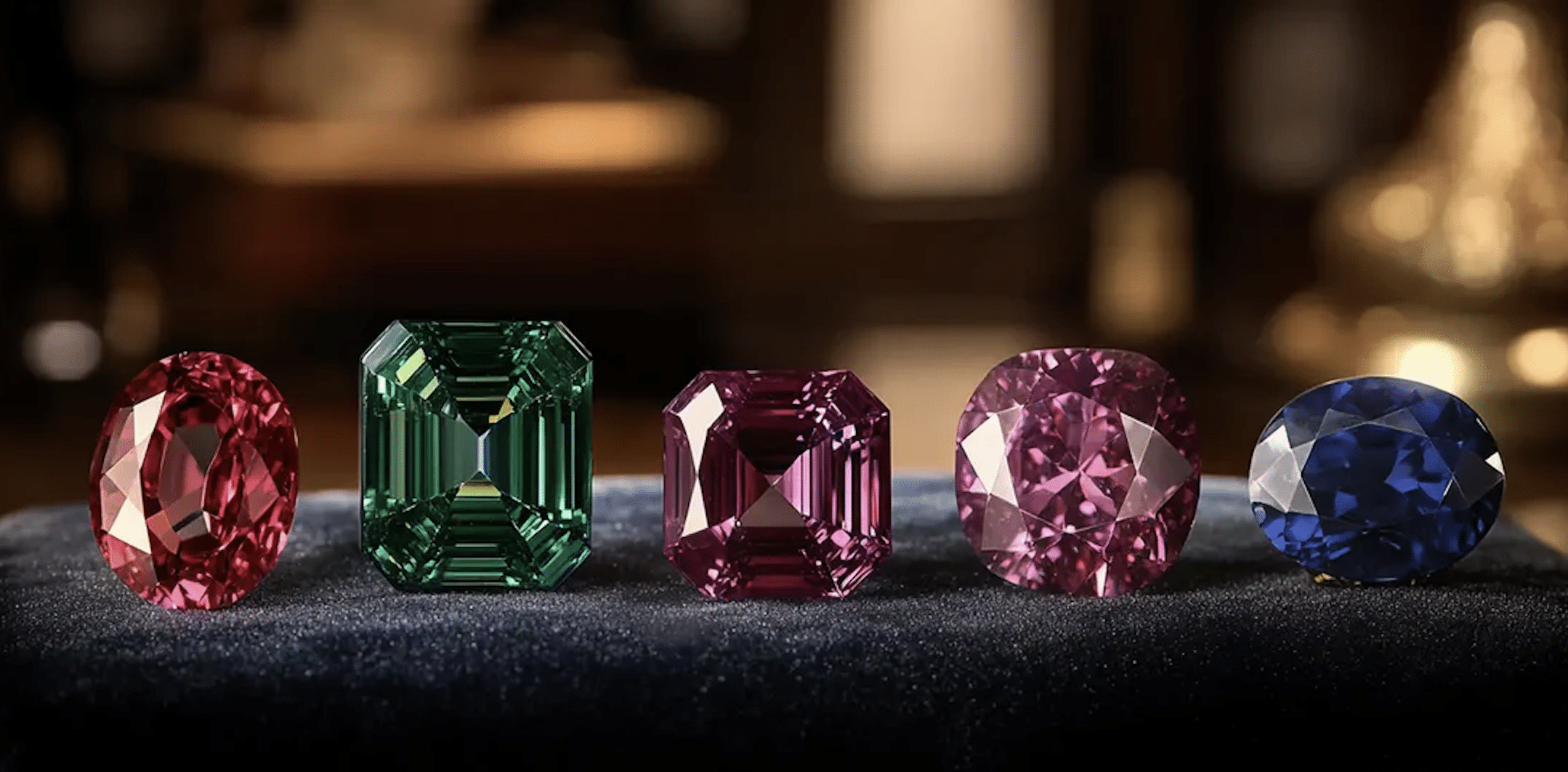
Where does the market for exceptional gems currently stand?
Blue diamonds, jadeite, pink diamonds… these natural precious stones rank among the rarest and most expensive in the market. For several years now, these gems and other precious stones have established themselves as genuine collector’s treasures, highly coveted by private investors, family offices, and major fortunes.
Five years ago, the precious stones market remained relatively discreet, driven mainly by seasoned collectors and luxury houses. Today, it attracts a far broader audience, fuelled by online sales and innovation within the sector — compounded by political and economic tensions that are accelerating the scarcity of natural and geological resources.
At PSPI, we follow this evolution closely. We take care to study this fast-changing sector of exceptional natural assets, with particular attention to the key considerations involved in securing them.
Precious Stones: Between Natural Rarity and Jewellery Craftsmanship
The Timeless Signatures of the Gem World
For centuries, four precious stones have dominated fine jewellery: the diamond, the emerald, the sapphire, and the ruby. This “Big Four” forms the historical bedrock of the market. In 2026, they remain at the heart of the industry’s finest creations and its most established benchmarks.
Their appeal rests on well-established quality criteria. Born from diamond grading, the famous “4Cs” — carat, colour, clarity, and cut — have gradually shaped standards across the entire market. Each stone reveals its own distinctive character, from the intense green of the emerald to the deep blue of the sapphire and the red of the ruby. Certain rare gems defy market standards altogether; their extreme scarcity calls for case-by-case valuation, as is often true of the rarest diamond varieties.
Beyond these criteria, these stones retain a singular power: they embody a form of timelessness and prestige. Linked to haute joaillerie and centuries of tradition, they remain enduring references, deeply woven into the collective imagination. These stones draw a clientele in search of lasting value, offering both aesthetic and patrimonial dimensions.
The Rise of Exceptional Gems
At the summit of the precious stones market, beyond the Big Four, certain exceptional gems stand out for their absolute rarity. They rank among the most sought-after in the world and command the highest price levels. The most discerning investors pursue these assets precisely for their patrimonial dimension.
Only a few years ago, natural fancy-colour diamonds were the preserve of a knowledgeable few. By 2026, they have become genuine trophy assets. The pink diamond has grown scarcer still following the closure of its major deposits, now reaching close to $1.19 million per carat. The blue diamond has reached even more extraordinary levels, trading around $3.93 million per carat.
Imperial jadeite, highly prized across Asia, can command up to $3 million per carat.
From Exceptional Stones to Haute Joaillerie
Beyond these figures lies a complementary dimension: the transformation of these stones into jewellery. While the gem carries intrinsic value, jewellery craftsmanship enhances both its perception and its worth.
The artisan’s hand, the precision of the cut, and the choice of setting all work to elevate the stone. In haute joaillerie, each piece becomes unique — at times, a genuine work of art. The hours devoted to its creation, sometimes numbering in the hundreds, contribute to bringing out its full brilliance.
To this is added an intangible, sentimental value. A piece of jewellery is never simply a stone: it carries a story and a patrimonial weight. Rarity creates value; jewellery amplifies its allure.
A Precious Stones Market in Transformation
Growing Scarcity Reshapes Demand
Today’s natural precious stones market is defined by a structural scarcity of supply. The closure of major mines, such as the Argyle mine in Australia, has sharply reduced the availability of coloured diamonds. At the same time, new discoveries remain limited, and developing a new deposit can take more than a decade.
This decline in production has created lasting pressure on supply. High-quality rare stones are increasingly sought after by investors, and certain provenances remain especially prized — Colombian emeralds, for instance, remain a benchmark, with their origin strongly underpinning their value.
Meanwhile, global demand is shifting rapidly. Historically dominated by Europe and the United States, the market is now turning toward Asia. China, Hong Kong, and Singapore account for a growing share of buyers, mirroring the rise of great fortunes across the continent.
Jadeite perfectly illustrates this trend. Highly sought after for its cultural significance, it enjoys strong momentum in Asian markets, where buyers now increasingly influence prices at international auctions. Other stones, such as Colombian emeralds, continue to stand apart as well — provenance remains a key valuation criterion, reinforcing their position within this segment of investment-grade stones.
On the macroeconomic front, today’s climate — inflation, geopolitical uncertainty, financial market volatility — is fuelling growing interest in tangible assets. Precious stones are emerging as a compelling tool for wealth diversification, particularly for investors seeking assets uncorrelated to traditional markets.
A World Demanding Rigorous Expertise
Investing in precious stones calls for specialist expertise. The market remains largely unstandardised, with asymmetric information and significant price variation depending on quality, origin, and certification.
Rigorous selection is therefore essential — this is not an asset class suited to a generalist approach or short-term speculation.
Authenticity remains the central concern. Several fundamental criteria must be verified:
- Certification by recognised laboratories, such as the Gemological Institute of America or the Swiss Gemmological Institute (SSEF)
- Full traceability of origin (e.g., Colombia, Burma, Sri Lanka)
- Analysis of any treatments applied
- Vigilance against fraud or overvaluation
The market is also being reshaped by the rise of synthetic diamonds. Produced in laboratories, they offer increasingly high quality at prices well below natural diamonds — a trend that sharpens the distinction between the two and, in turn, reinforces the value of exceptional natural stones.
New gem-imitation products are also emerging, at times made from composite materials or polymers (sometimes mistakenly referred to as “alternative diamonds”). While they cater to a more accessible segment of demand, they possess neither the rarity nor the intrinsic value of genuine natural stones — a distinction that can create confusion within the market.
Finally, it bears emphasising that precious stones remain a relatively illiquid asset class. Resale timelines can be lengthy, and prices are never guaranteed. As such, they belong within a long-term investment strategy, oriented toward wealth transmission.
Exceptional Wealth Demands Exceptional Protection
As the patrimonial significance of these gems continues to grow, they demand protection equal to their value. Theft, deterioration, international transport — the risks are manifold, calling for bespoke insurance solutions integrated within a broader wealth management strategy. This is the mission of a specialist insurance broker.
By 2026, precious stones have become genuine patrimonial assets, sitting at the intersection of luxury, geology, and finance. Holding them demands rigorous traceability and secure conservation. Reach out to our experts, who will take care to identify the solution best suited to your situation.
As a licensed Swiss insurance broker, we guarantee reliable, compliant coverage, and we support the security and enhancement of your exceptional assets.
At PSPI, this approach allows us to support the most discerning owners over the long term. The Art of Protection defines our standard of excellence.
GemGenève
The dynamism of the precious stones market is set to be confirmed once again at the next edition of GemGenève, the leading international gathering dedicated to jewellery and gemmology, taking place in Geneva from May 7 to 10, 2026. The event will bring together dealers, collectors, jewellery houses, and experts from around the world — a further testament to the growing appetite for exceptional gems and stones of high traceability.
Sources
Berr & Partners marché des pierres